
















Wissen
Deep Dive into EU/North American Exhibition Fire Safety Standards: Does Your Table Cover and Backdrop Truly Comply with NFPA 701 and B1?
Nov
I. Introduction: The Criticality of Compliance Beyond Aesthetics
In the competitive world of international trade shows and exhibitions, branding and aesthetics are paramount. However, beneath the visual appeal of a striking backdrop or a neatly branded table cover lies a silent, non-negotiable requirement that dictates whether your display is even allowed on the show floor: Fire Safety Compliance.
For global procurement managers, event organizers, and brand directors, navigating the maze of international fire safety standards can be daunting. What works for an event in Dallas may be immediately rejected in Düsseldorf. The difference between passing and failing often rests on obscure material certifications, leading to costly last-minute replacements, significant on-site fines, or, in extreme cases, the complete shutdown of a stand.
This article provides a comprehensive deep dive into the two most critical textile flammability standards governing trade show environments: NFPA 701 (North America) and DIN 4102-B1 (European Union/Germany). We will detail what these certifications mean, how they differ, the risks of non-compliance, and the vital role your supplier plays in ensuring your exhibition assets are truly compliant, not just aesthetically pleasing.
II. Understanding the North American Standard: NFPA 701
Der National Fire Protection Association (NFPA) 701 Standard is the benchmark for the U.S. and is widely accepted across Canada and Mexico. It is specifically designed to assess the flammability of draperies, curtains, and other window treatments and is the primary test used for large textile materials in public assembly areas, including exhibition booths.
A. What NFPA 701 Measures
NFPA 701 is a performance test, meaning it focuses on how a material reacts to flame, rather than its chemical composition.
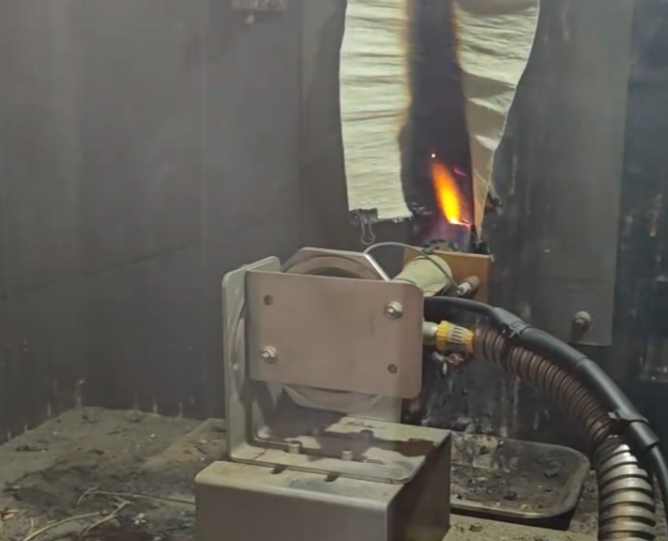
- Test Method 1 (Small Specimens): Used for lightweight fabrics (typically below $21 \text{ oz/yd}^2$) such as most table covers and thin backdrop fabrics. The test involves exposing the material to a small flame for a specified time. Compliance is determined by three main factors:
- Afterflame Time: The fabric must cease flaming within a set number of seconds after the fire source is removed.
- Char Length: The amount of material consumed or damaged by the flame must be limited.
- Flaming Drippings: Crucially, the material must not release any flaming molten particles that could ignite flooring or surrounding materials. This is a common failure point for synthetic fabrics.
- Test Method 2 (Large Specimens): Used for heavier materials or those with coatings, which are less common for basic pop-up backdrops but may apply to thick canopy tents.
B. The Legal and Operational Ramifications in the U.S.
In the U.S., event halls, fire marshals, and convention centers have the final say. If your table cover or backdrop is deemed non-compliant, you will face immediate action:
- Financial Penalties: Fines can range from hundreds to thousands of dollars, levied by the venue or the fire marshal.
- Forced Removal/Treatment: You may be forced to remove the item or have it sprayed with a chemical fire retardant on-site. This treatment is often costly, can damage the graphic print, and may not guarantee compliance.
- Liability: In the event of an incident, non-compliant materials expose the exhibiting company to severe legal liability and insurance complications.
Key Supplier Responsibility: The supplier must provide an official, dated Certificate of Flammability explicitly stating that the specific fabric used (e.g., “600D Polyester”) has passed the NFPA 701 test and identifying the certifying body. Simple claims of “flame-resistant” are insufficient.
III. The European Standard: DIN 4102-B1
The European Union does not have a single, unified flammability standard for textiles. However, the German standard DIN 4102-B1 (often referred to simply as B1) is the most commonly requested and strictest standard in Central Europe, particularly in exhibition hubs like Germany, France, and Italy.
A. What B1 Measures (The “Brand Test”)
B1 is generally considered a more demanding standard than NFPA 701 for synthetic textiles, focusing on fire resistance and the spread of combustion.
- Test Principle (The “Schachtofen Test”): The material is subjected to a defined flame source and temperature within a vertical fire shaft (Schachtofen).
- Compliance Criteria: The material is tested for its ability to resist continuous flaming. For a material to achieve the B1 classification, it must be “schwer entflammbar” (low flammability/hardly flammable).
- Critical Difference: The B1 standard specifically evaluates the material’s tendency to spread flame and its capacity to self-extinguish under strict conditions. Many fabrics that pass NFPA 701 may fail the B1 test due to the different testing apparatus and intensity.
B. The EU Compliance Landscape and Euroclass
While B1 is dominant, the EU is moving toward the Euroclass system, specifically EN 13501-1. This standard provides a common European fire classification (Classes A1, A2, B, C, D, E, F).
- B1 Equivalence: Materials passing B1 are generally comparable to the higher Euroclasses (often B or C), but since the Euroclass system involves additional tests for smoke production and flaming droplets, B1 certification remains the practical, default requirement for most major European exhibition venues.
- Supplier Expertise: A competent global supplier should be able to provide the B1 certificate and advise on Euroclass compliance, ensuring your assets are ready for a venue in London (where the British standard is BS 5867) or Paris.
IV. NFPA 701 vs. B1: Key Differences and Procurement Strategy
Procurement teams aiming for true global consistency must understand that a material is not inherently interchangeable between the two standards.
| Besonderheit | NFPA 701 (North America) | DIN 4102-B1 (Central Europe) |
| Primary Focus | Limit flaming droppings and afterflame time. | Resist continuous spread of flame (Low Flammability). |
| Test Severity | Generally less severe for synthetic base fabrics. | Considered highly demanding; uses a vertical fire shaft. |
| Testing Apparatus | Small flame application apparatus. | Schachtofen (Fire Shaft). |
| Recertification | Generally required only if chemical treatment is washed out. | Highly recommended to re-test batches for consistency. |
| Status | U.S. legal standard for public assembly textiles. | De-facto exhibition standard across Central Europe. |
The Strategic Dilemma: One Fabric or Two?
The optimal procurement strategy for global brands depends on volume and risk:
- Single Global Fabric (High Investment): Source a textile that is explicitly tested and certified to both NFPA 701 and B1 standards. This is the gold standard for global consistency but requires a higher upfront material cost and a specialized supplier. This eliminates all risk.
- Dual Regional Fabrics (Operational Complexity): Procure two separate fabric batches—one certified to NFPA 701 for the Americas and one certified to B1 for the EU. This may offer slightly better material pricing but introduces inventory complexity and the risk of shipping the wrong product to the wrong continent.
Warning for Procurement: Never assume compliance. “Flame resistant” or “FR” is a marketing term. You need the specific, dated, and signed test certificate for the exact fabric weight and coating you are purchasing.
V. How to Verify Compliance and Mitigate Risk
Verifying compliance is the final layer of defense against exhibition risks. This process moves beyond the supplier’s sales pitch and into operational due diligence.
A. Due Diligence on the Certificate
- Specificity: The certificate must explicitly name the material (e.g., “Strong-Tex 600D Fabric”), the weight, and the exact process (e.g., “Flame Retardant Impregnation”). Generic certificates for “Polyester” are worthless.
- Date and Validity: Certificates are not eternal. Ensure the test date is recent (typically within 1-2 years) and that the certifying body is recognized (e.g., a recognized testing laboratory in the US or Germany).
- Language: For the EU, insist on the B1 certificate being in German or accompanied by a certified translation, as this is what local fire marshals require.
B. The Role of Chemical Treatment (The Finishing Process)
Fabrics achieve flame resistance in one of two ways, with significant implications for longevity:
- Inherently Flame Retardant (IFR): The chemical compound is woven directly into the synthetic fiber during manufacturing. This material retains its FR property for the life of the product, even after washing or exposure to the elements. IFR is the preferred choice for high-end, long-term assets like backdrops.
- Topically Treated: The finished fabric is sprayed or dipped in a chemical fire-retardant solution. This solution can wash out, wear off, or degrade over time. If a topical treatment is used, the fabric must be clearly marked as “Do Not Wash” and may require re-testing after significant use.
Procurement must specify IFR fabrics for any product (especially table covers) that is likely to be cleaned.
C. On-Site Preparation and Documentation
Your exhibition team must be prepared:
- Documentation Kit: Ensure a physical copy of the NFPA 701 and/or B1 certificate is placed in the on-site organizer’s binder.
- Supplier Contact: Have the supplier’s technical contact information readily available in case the fire marshal requests verification or clarification.
- Inspection Awareness: Instruct stand staff that if a fire marshal attempts a “match test” (illegally attempting to burn a small piece of the material), they must politely refuse and immediately present the official certificate.
VI. Conclusion: Compliance as a Competitive Differentiator
In a globalized exhibition economy, compliance is no longer a bureaucratic chore; it is a critical competitive differentiator and a fundamental risk management tool. Investing in materials certified to the highest international standards—be it NFPA 701 for your North American tours or B1 for your European campaigns—is an investment that reduces TCO by eliminating the costs of fines, last-minute fixes, and liability exposure.
A supplier that simply claims “FR” is a liability. A strategic partner like Strong Display provides the specific, dated, laboratory-tested documentation required by every major venue globally, ensuring your brand is always protected, compliant, and ready to engage.
The final truth: Your table cover and backdrops are only as compliant as the paper trail that proves it. Ensure your supplier provides the evidence required to protect your brand and your investment, globally.