














Conocimiento
The Invisible Killer of Outdoor Events: Why 80% of Display Tents Fail in High Winds?
Mar
I. Introduction: The Event Manager’s Worst Nightmare
It’s a perfect Saturday morning. Your branding is up, the 10×10 custom canopy looks sharp, and the crowd is arriving. Then, a sudden 15 mph gust hits. Within seconds, a cheap aluminum frame buckles, the canopy transforms into a sail, and your premium display becomes a safety hazard.
In the world of event marketing, reliability isn’t just a feature—it’s insurance. But why do some tents stand firm while others fold like paper? The answer lies in the physics of wind pressure and the hidden engineering of the frame.
II. The Physics of Failure: Why Thickness Matters
Most buyers compare tents based on “look” and “price.” Professional engineers compare them based on Wind Load.
The pressure ($P$) exerted by wind on a flat surface (like your tent’s side wall) increases exponentially with wind speed ($v$). The simplified formula is:
$$P \approx 0.613 \cdot v^2$$
(Where $P$ is in $N/m^2$ and $v$ is in $m/s$)
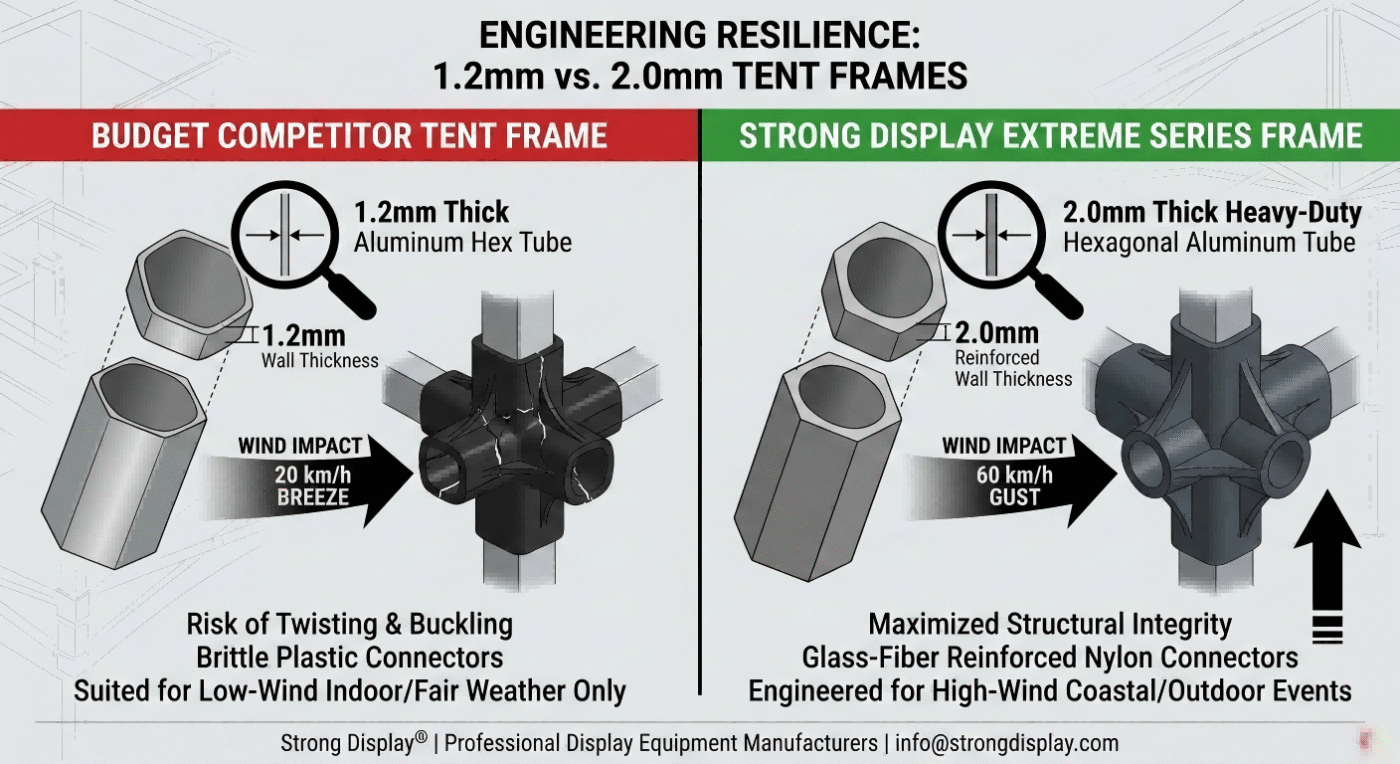
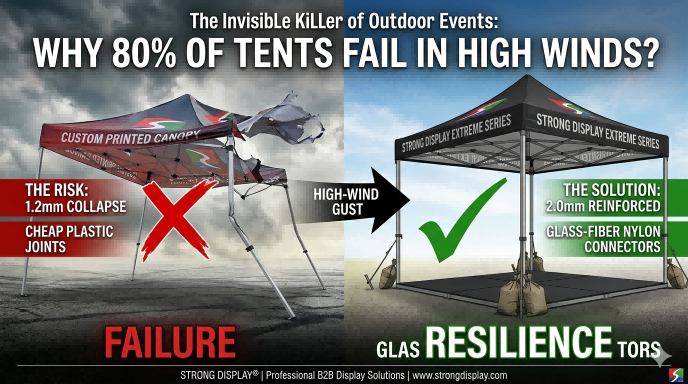
This means if the wind speed doubles, the force hitting your tent quadruples. A standard 1.2mm wall thickness frame might handle a breeze, but at Strong Display, we utilize 2.0mm heavy-duty hexagonal aluminum. That extra 0.8mm isn’t just weight—it’s a massive leap in structural integrity that prevents the frame from “twisting” under torque.
III. The 3 “Weak Links” Most Manufacturers Hide
To hit a low price point, many OEM factories cut corners where you can’t see them. Here is what to look for:
- The Joint Material (Nylon vs. Recycled Plastic): Cheap tents use brittle plastic connectors that snap under sudden tension. We use Glass-Fiber Reinforced Nylon, which offers the flexibility to absorb shock without cracking.
- The Peak Tensioner: A sagging roof collects wind like a parachute. Our professional series features a spring-loaded peak pole that ensures the fabric stays “drum-tight,” allowing wind to glide over rather than push against it.
- The Footplate Construction: Small, thin feet are easily uprooted. Look for heavy-duty galvanized steel footplates with multi-point pegging holes.
IV. Case Study: The 40mph Survival Test
Last season, a client in a coastal region replaced their entire fleet with Strong Display’s Extreme Series. While neighboring booths had to dismantle during a sudden storm, our reinforced hexagonal frames remained anchored.
“The difference wasn’t just that the tent stayed up; it was the peace of mind. We didn’t have to worry about liability or equipment damage.” — Lead Event Coordinator, Global Tech Corp.
V. Conclusion: Investing in Resilience
When you buy a display tent, you aren’t just buying fabric and metal; you are buying the certainty that your event will proceed regardless of the weather. Saving 20% on a “budget” tent often leads to a 100% loss when the first storm hits.