















Знание
The Ultimate Showdown: UV Printing vs. Dye Sublimation for Large Backdrops—A B2B Buyer’s Guide to Color Management and Outdoor Durability
Nov
Introduction: The Critical Choice for Brand Asset Longevity
For brand managers, event coordinators, and procurement professionals, a large backdrop, Pop Up Wall, or Table Cover is more than just a graphic; it’s a significant investment in a brand’s physical presence. The decision between UV Printing and Dye Sublimation is arguably the most crucial technical choice, directly impacting the graphic’s visual fidelity, longevity, and overall return on investment (ROI).
At Strong Display, we understand that B2B buyers require detailed, technical insights, not just marketing claims. This comprehensive guide dissects the fundamental differences, applications, and performance metrics of these two leading print technologies, focusing on the critical areas of color management and outdoor fade resistance for your large display assets.
Part I: Understanding the Core Technology
The primary difference between UV and Dye Sublimation lies in how the ink (or dye) interacts with the substrate (the fabric or material).
1. Dye Sublimation Printing (The “Infusion” Method)
Dye Sublimation is the go-to choice for soft signage and fabric-based displays. It is a two-step process that achieves a deep, vibrant print:
- Process: Special water-based dye is printed onto a transfer paper. This paper is then placed against the polyester fabric and run through a high-temperature heat press. The heat converts the solid dye into a gas (sublimation), which deeply penetrates and fuses with the synthetic polyester fibers at a molecular level.
- Result: The image is embedded within the fabric, not sitting on its surface.
- Best For: Pop Up Walls, Backdrops, Table Covers, and Beach Flags requiring folding, washing, and a soft, natural drape.
2. UV Printing (The “Cured Surface” Method)
UV printing is known for its versatility across both rigid and flexible substrates, including certain fabrics.
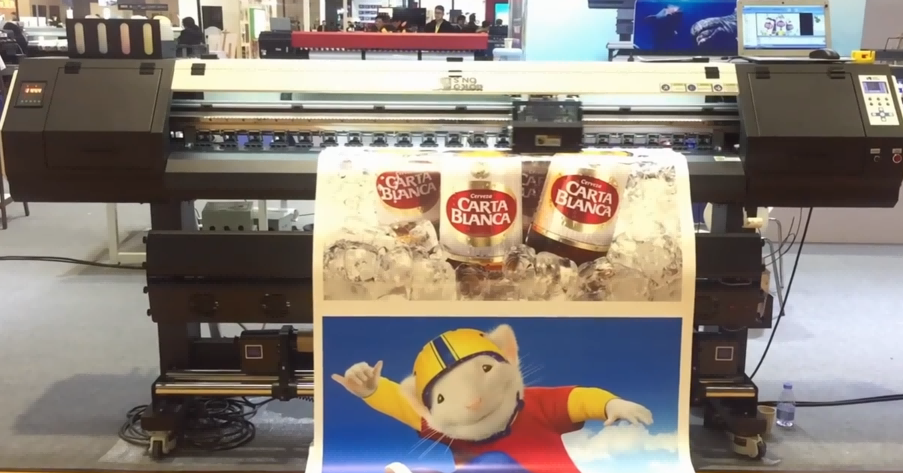
- Process: Specialized liquid ink is jetted directly onto the print material (fabric, PVC, vinyl, etc.). Immediately after application, the ink is exposed to high-intensity Ultraviolet (UV) light, which instantly “cures” and hardens the liquid ink into a solid film.
- Result: The ink sits as a durable, slightly raised layer on top of the material’s surface.
- Best For: Rigid displays (like acrylic or PVC), large vinyl banners, and applications where maximum outdoor durability is the priority.
Part II: The Color Management Challenge
For professional brands, color consistency is non-negotiable. It underpins brand identity across all physical and digital touchpoints.
A. Color Vibrancy and Depth
| Factor | Dye Sublimation | UV Printing | B2B Procurement Impact |
| Vibrancy | Superior. Because the dye is molecularly infused, light reflects through the colored fibers, resulting in exceptionally rich, continuous-tone, and photo-realistic colors. Ideal for backlit graphics (e.g., SEG Lightboxes). | Very Good, but on the surface. Colors are sharp and bright, but the opaque nature of the ink can make the print appear slightly less luminous than dye sub, particularly in shadows or gradients. | Brand Fidelity: Dye Sub is preferred when an exact match to a vibrant, specific color (e.g., a signature red or blue) is paramount. |
| Gradients/Tones | Flawless. The infusion process allows for perfect color blending and smooth transitions. | Sharp. Excellent for micro-typography, fine lines, and crisp details due to the precise surface application. | Design Complexity: UV excels where fine text or codes must be perfectly legible from a short distance. |
| Color Consistency (Batch-to-Batch) | High, but requires strict temperature and press calibration (the sublimation process). | High, with immediate curing simplifying the post-print process, but color profile must be perfectly managed across all substrates. | Mass Production: A reliable supplier like Strong Display must have expert ICC profiling for both methods to ensure exact color repeatability across multiple batches and years. |
B. The Fabric Feel and Crease Factor
The texture and handling characteristics of the final display material are critical for B2B logistics and reuse:
- Dye Sublimation: Since the dye is in the fiber, the fabric retains its original soft drape, flexibility, and breathability. Prints can be folded, shipped, and stored with minimal risk of cracking or visible creasing, simplifying packing for multi-event campaigns.
- UV Printing (on Fabric): Because the ink sits as a layer on the surface, the fabric can feel slightly stiffer and may have a “memory” for folds. If folded tightly, the cured ink layer can be prone to cracking or white stress marks along the creases, severely impacting graphic reuse.
Procurement Insight: If your displays (Backdrops, Pop Up Walls) are frequently shipped, set up, and repacked by field teams, Dye Sublimation drastically reduces the risk of graphic damage during transit.
Part III: Outdoor Fade Resistance and Durability
For Beach Flags, Canopy Tents, and outdoor Pop Up Banners, UV resistance and overall durability determine the asset’s lifespan and, by extension, its ROI.
A. Fade Resistance (UV Stability)
| Factor | Dye Sublimation | UV Printing | Outdoor Performance Implication |
| Mechanism | Dye is fused into the polyester molecule. While durable, prolonged, intense UV exposure will gradually break down the dye over the years, similar to any dyed material. | Ink is a tough, polymer layer on the surface, specifically formulated with high UV inhibitors that are instantly cured. | Winner: UV Printing. It offers the highest resistance to color degradation and fading during prolonged sun exposure (e.g., permanent outdoor retail signage or Beach Flags used all summer). |
| Water/Abrasion | Excellent. The print is chemically part of the fabric, making it washable, highly scratch-resistant, and weather-proof. | Excellent. The cured ink is a resilient, abrasion-resistant polymer shell. It is completely waterproof immediately after curing. | Abrasion Tie: Both methods yield highly durable prints. Dye Sub’s washability is a major advantage for frequently used/soiled Table Covers. |
| Cleaning | Machine washable (polyester fabrics). A significant advantage for Canopy Tent tops and Table Covers used for food/beverage events. | Surface Wipe only. Washing machines would damage the surface ink layer. | Hygiene: For high-traffic, multi-use assets, Dye Sub’s ease of cleaning extends its reusable lifespan. |
B. Structural Durability (Wind and Weather)
For products like Canopy Tents, the print method affects not just the color, but the material’s structural integrity:
- UV Printed Tents: Often done on PVC or heavy vinyl. The thick ink and substrate provide a rugged, heavy-duty shelter layer, often more structurally rigid and weather-resistant than a thin fabric top.
- Dye Sublimated Tents: Done on polyester fabric. The fabric retains its flexibility and lightweight nature, making the tent easier to transport and set up, though perhaps less suited for semi-permanent, high-wind conditions unless the frame is specifically engineered.
Procurement Insight: If the asset is for high-wind, semi-permanent outdoor use (e.g., construction sites, long-term events), the durability and versatility of a UV Printed vinyl option are often preferred. For frequent, mobile use (e.g., farmers markets, brand activations), Dye Sublimation on fabric is the choice due to superior handling.
Part IV: Procurement Strategy and ROI Calculation
The choice should align with the asset’s intended lifecycle and deployment environment. A smart B2B buyer uses a Total Cost of Ownership (TCO) model.
1. The Short-Term vs. Long-Term Investment
| Scenario | Recommended Technology | Rationale (TCO Focus) |
| High-End Backlit Displays (SEG) | Dye Sublimation | Superior light diffusion, color vibrancy, and a soft, premium retail finish justify the higher initial setup cost. |
| Outdoor Vinyl Banners / Rigid Signage | UV Printing | Best-in-class fade resistance and ability to print on diverse, rugged substrates (PVC, Metal, etc.) maximize the graphic’s lifespan in direct sunlight. |
| High-Rotation, Foldable Backdrops | Dye Sublimation | Resistance to creasing, ease of washing, and lightweight shipping drastically reduce damage and operational costs over 10+ uses. |
| Large-Scale, Single-Use Graphics | UV Printing | Can be faster for high-volume, quick-turnaround production, especially on versatile materials, potentially offering a lower initial unit cost. |
2. The Strong Display Commitment to Quality
Regardless of the technology you choose for your Backdrops, Canopy Tents, or Beach Flags, a reliable supplier must address the core technical challenges:
- ICC Colour Profiling: We utilize advanced colour spectrometry and International Color Consortium (ICC) profiling to ensure that your digital artwork translates into a precise, repeatable physical color, whether using dye sublimation or UV inks.
- Fabric/Ink Matching: We do not apply UV ink to every fabric. We select only those UV-grade textiles that minimize the surface stiffness and maximize adhesion, ensuring minimal cracking.
- Post-Production Care: For dye sublimation, our integrated, high-speed heat presses ensure uniform dye penetration, maximizing both vibrancy and UV resistance before the product leaves our facility.
Conclusion: Choosing Your Technology Partner
The decision between UV and Dye Sublimation is not about “which is better,” but “which is better for your specific application and logistical needs.”
- Choose Dye Sublimation for the highest color vibrancy, softest finish, creasing resistance, and washability—essential for frequently handled and repositioned fabric displays.
- Choose UV Printing for the maximum outdoor fade resistance, material versatility, and ultimate durability on heavy-duty vinyls, rigid boards, and semi-permanent outdoor fixtures.
By understanding the technical nuances outlined above, you can make a strategic procurement decision that guarantees the visual integrity and longevity of your brand assets, maximizing the ROI on every display piece.
Are you planning a multi-event campaign with varied display needs? We can provide a detailed cost breakdown and TCO analysis comparing a blended approach: UV-printed Beach Flags and Dye Sublimated Pop Up Walls, ensuring you get the best performance for every asset.